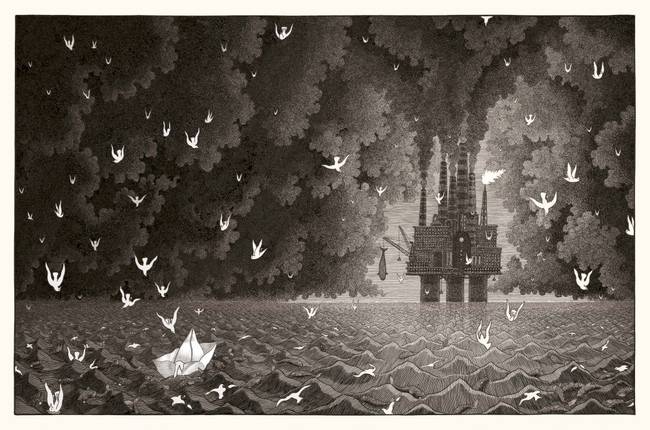
I was listening to a podcast when, in a brief comment about the tension between the sacred and the profane, one of the hosts dropped this quote:
“The daemonism of chthonian nature is the West’s dirty secret.”
Powerfully succinct, beautiful sentence. That’s by the (very) controversial Camille Paglia in her book Sexual Personae.
In the podcast, I heard the quote in Spanish, makes it more thrilling and fantastic, and rolls off the tongue:
“El carácter demónico de la naturaleza ctónica es el sucio secreto que guarda Occidente”
The first time I read that was some 20-odd years ago, at night, during a period of my life when I was working on an oil rig in lake Maracaibo.
Oil rigs are the most literal of the profane cathedrals: dirty structures built to suck the juices of the monsters of our past. At night, their lights are colorful, bright, beautiful, enticing.
Sexual Personae deals in part with the struggle between the Apollonian, the realm of line, form, distance, hierarchy, light and artistic order, and the Dionysian, an overloaded term that Paglia decided to replace with the chthonian: the underground world of blood, decay, desire, fertility, illness, birth and death.
That quote is a diagnosis of one of the great Western illusions: that civilization has somehow split from nature. We prefer nature when it has been framed, named, classified, landscaped, engineered or turned into a view. We repress the lower layer: the body, reproduction, decomposition, violence, waste, dependence, mortality. By chthonian, Paglia does not mean evil in a simple moral sense. The “dirty secret” is not that nature is evil, it’s that even our cleanest structures are still built over something dark, bodily and indifferent to us.
That evening, destroyed after a nerve wracking ride with other dirty men in a coffin-like boat, that sentence was like a lightning bolt. A catatumbo lighting bolt, to be more precise.
We deal with this illusion every day, unconsciously. Perhaps because fully realizing it would be overwhelming. But maybe, by slowly embracing the chthonian nature, we move a little closer to wholeness.
